
What does a surf lesson in Lacanau look like?
You want to know what a surf lesson in Lacanau looks like before booking, and most importantly reassure yourself with “will I be able to do it?”. Spoiler: yes, and you’ll be catching your first waves faster than you think.
Concretely, a lesson happens in 3 stages: welcome + equipment, safety briefing + technique on the sand, then practice in the water (usually on the whitewater at first). In Lacanau, the instructor picks the best spot based on conditions and your level, which makes all the difference on a beach break. At Ocean Ride, the structure is very clear: meet 20 minutes early, direct beach access, board/wetsuit selection, short walk, then alternating instructions + practice.
- Meet 20 min early at the school: you get equipped calmly and head out stress-free.
- The instructor picks the spot based on waves, tide and group level.
- The lesson alternates: safety + warm-up + technique on the sand → water session (paddling, positioning, take-off).
- In Lacanau, we talk about rip currents: learning to spot them is part of safety training.
- End of session: debrief + clear advice to progress at the next lesson.
Key takeaways
The 10 steps
If you want the straight answer to “what does a surf lesson look like”, here it is:
- You arrive at the school (ideally 20 min early).
- You are given a suitable wetsuit.
- The instructor picks a stable board (usually a softboard).
- Briefing: conditions of the day (waves, tide, zone).
- Safety: rules, distances, board control, right of way.
- Warm-up + mobility (shoulders, hips, legs).
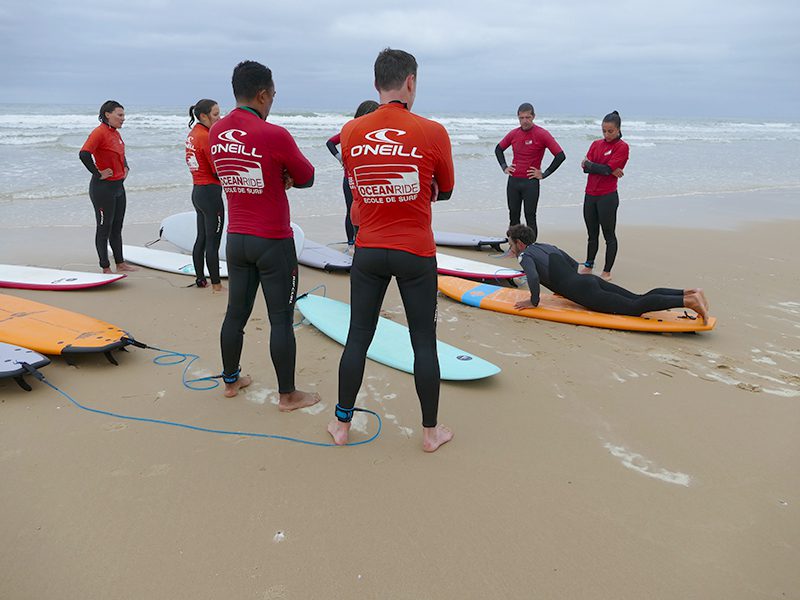
- Technique on the sand: stance, paddling, take-off (the pop-up).
- In the water: learning to position yourself and paddle at the right moment.
- First waves: whitewater, then small waves as you progress.
- Back on the beach: debrief + improvement points + goals.
How a surf lesson unfolds: from the meeting point to your first wave
1) You arrive (20 minutes early) and ask your questions
First good point: at Ocean Ride, the meeting point is at the school right on the seafront, facing the spot. No need to walk halfway across the beach with your board.
This is also the moment where you mention:
- your actual level (“complete beginner”, “I’ve done 2 lessons before”, etc.)
- your comfort in the water (important, especially if waves make you nervous)
- your goal (stand up, understand the ocean, progress fast…)
The more honest you are, the better the lesson is tailored. And that’s exactly what makes a beginner progress quickly.
2) Equipment: wetsuit + board (matched to your build)
Next comes equipment: you put on your wetsuit, then choose your board with the instructor.
For a first lesson, it’s almost always:
- a foam board (softboard): stable, comfortable, safe
- enough volume: the more it floats, the easier it is to catch waves
- a leash (ankle cord): essential
Quick truth: a board that’s “too small because it looks cool” is the best way to paddle for 2 hours and catch zero waves. In lessons, we focus on efficiency.
3) “Short walk”: the instructor takes you to the right spot
This moment might seem trivial, but it’s very important. The instructor picks the best surf spot based on the day’s conditions and the group’s level, then you walk there together.
Why does this matter so much in Lacanau?
- the sandy bottom shifts — sandbars move constantly
- the wave can be gentle 100m further… or much more powerful
In short: instead of “trial and error”, you end up in the right place straight away.
4) Conditions briefing + safety: the basics before hitting the water
Before even talking technique, we talk ocean:
- where to enter / where to exit
- where you are allowed to go
- how to control your board to avoid injuring someone
- right of way rules (the highway code, surf edition)
This part is non-negotiable: it’s what allows you to feel confident, go for it, and enjoy. Schools typically structure the lesson with a theory + practice approach, alternating sand instructions with in-water sessions.
5) Warm-up: prepare your body (and surf better)
You might think “I came to glide, not work out”… and yet: a good warm-up can save your whole session.
We warm up:
- shoulders (paddling)
- back (core stability)
- hips (balance)
- legs (take-off)
The result: less fatigue, fewer cramps, and a cleaner take-off.
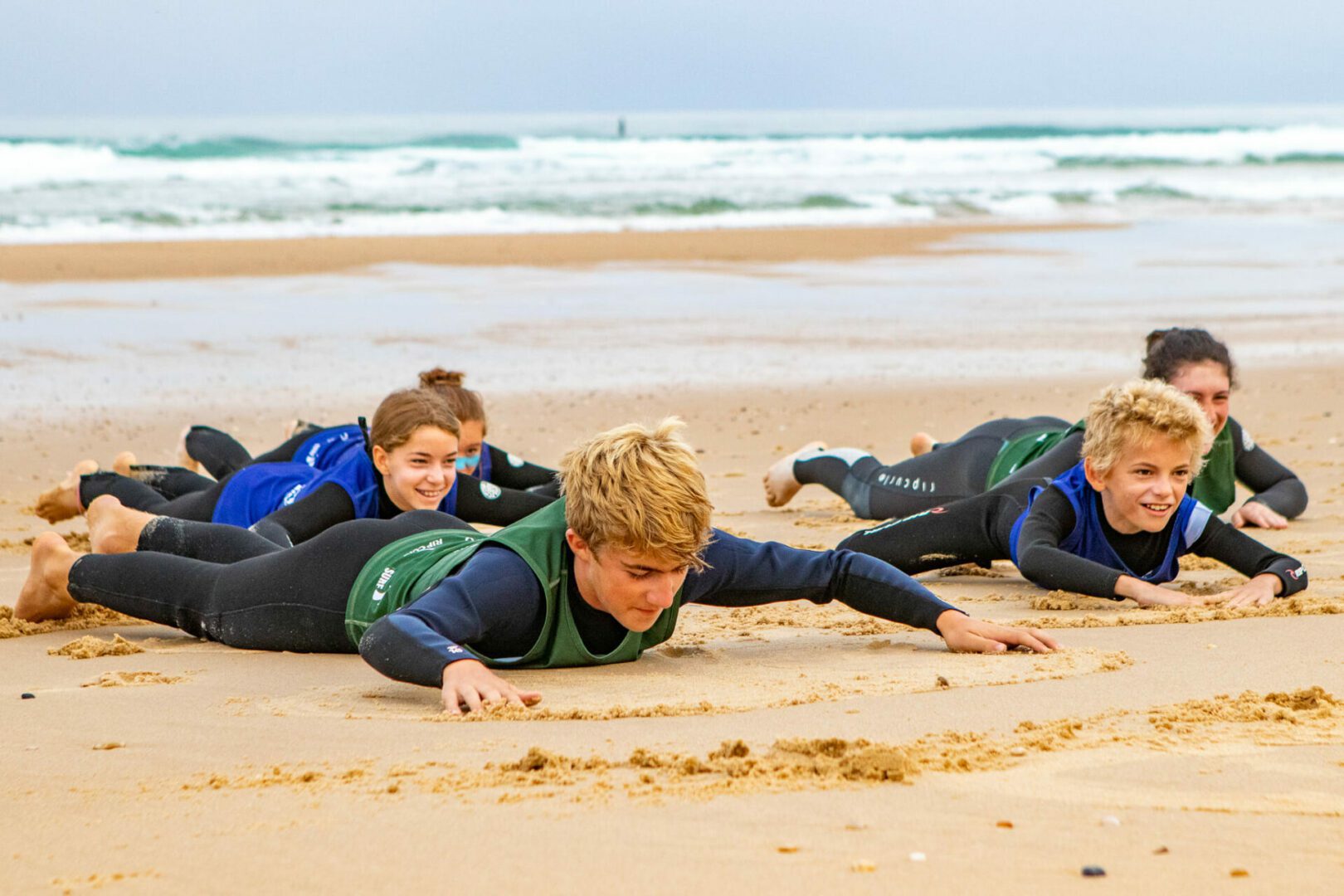
6) Technique on the sand: your take-off becomes automatic
This is THE part where you truly understand what a surf lesson is about: you’re not thrown into the water and left to figure it out. You repeat on dry land, correct, and memorise.
You typically work on:
- position on the board (chest, gaze, centre of gravity)
- paddling (reach + relaxation)
- take-off (the pop-up): hands, push, foot placement
- standing posture: bent knees, aligned shoulders, eyes forward
The take-off is often the “blockage” for beginners… but in reality, it’s just a matter of method + repetition.
7) Into the water: learning timing and gliding (usually in the whitewater)
Then: into the water!
For a first lesson, you usually start in the whitewater: already broken waves, softer and easier to learn on.
You practise:
- positioning yourself in the right zone
- paddling at the right moment
- keeping your speed
- standing up at the right timing
The surf instructor corrects you in real time: “look ahead”, “paddle 3 more strokes”, “put your hands lower”, “bend your knees”.
And that’s where you catch your first waves. Not necessarily long ones at first… but enough to give you that “OK, I get it!” feeling.
8) Debrief + goals: you leave with a clear path to progress
At the end of the session, back on the beach, you review:
- what you nailed
- what’s making you fall (usually gaze or foot placement)
- and most importantly: what to work on at the next lesson
This mini action plan is what makes you improve session after session.
Safety in Lacanau: rip currents and simple rules
You sometimes hear “watch out for the currents” and think: “Whoa, is it dangerous?”. The right mindset is: respect + method + supervision.
Rip currents: the simple version
A rip current is a deeper zone formed between sandbars. It can look calm… but it creates a current that pulls you out to sea. We explain these phenomena (waves, tides, rip currents) and how to avoid them in our article All about the ocean: waves, tides, rip currents and their dangers.
The 5 golden rules for beginners
- 1. Stay in the zone indicated by the instructor.
- 2. Keep your board close (leash + control).
- 3. Protect your head when wiping out.
- 4. Don’t fight a current: stay calm and follow the instructor’s guidance.
- 5. Respect distances (safety + good vibes).
These rules are the foundation of a well-supervised lesson: you feel safe, so you progress.
Your first surf lesson: what you’ll really learn
The “invisible” skills that make the difference
When people think surfing, they think “standing up”. But your first lesson is really about:
- posture (balance, core, flexibility)
- efficient paddling (otherwise you’ll exhaust yourself)
- timing (the wave is a 3-second window)
- reading the lineup (where it pushes, where it breaks, where it carries you)
That’s exactly why a lesson is more effective than “just giving it a go alone”.
What most beginners achieve in their first session
And most importantly: you leave thinking “ok, this is doable”.
Beginner checklist: come prepared, leave happy
| ✅ What to bring | ❌ What to avoid before the lesson |
|---|---|
| Swimwear / towel | A heavy meal |
| Water bottle | Alcohol (bad idea + safety risk) |
| Sunscreen (even on cloudy days) | “I went to bed at 3am and I’m surfing at 9am” (your take-off will suffer) |
| Hair tie if needed | |
| A light snack for after |
After your first lesson: progression, levels and options in Lacanau
Typical progression (simplified)
If you want to accelerate your progress, the “surf camp” format (several sessions close together) is usually the most effective.
Group or private: you choose your style
- Group lessons: great atmosphere, very motivating, you also learn by watching others.
- Private lesson: 100% personalised coaching (1 to 3 people), ideal for a specific goal.
Now you know what a surf lesson in Lacanau looks like: arrive 20 minutes early, get equipped, let the instructor pick the spot, safety briefing + warm-up, technique on the sand, then practice in the water with coaching until your first waves. If you want to turn the desire into a real session (and avoid beginner mistakes), the simplest step is to book your lesson in Lacanau at Ocean Ride: you save time, progress faster, and surf in great conditions.
FAQ – What does a surf lesson look like?
At Ocean Ride, depending on the package, teen/adult lessons last 1h30. The meeting point is 20 minutes before to get equipped.
Yes, you can learn the basics and catch your first waves in the first session (usually in the whitewater). But to become more independent and progress further, a multi-lesson surf camp is ideal.
The take-off isn’t “hard”, it’s mostly technical: hand placement, timing, gaze, feet. In lessons, you repeat it on the sand then in the water, which speeds up learning enormously.
Stay calm, don’t fight the current, signal if needed, and follow the safety briefing instructions. In Lacanau, understanding rip currents is part of the supervised learning experience.
