
How to maintain your surfboard to extend its lifespan
Surfboard maintenance is an essential topic for any surfer, whether beginner or experienced. A well-maintained board
glides better, lasts longer, and offers a better riding experience.
In this practical guide, we explain how to take care of your surfboard step by step, with tips that are easy to apply
before, during, and after every surf session. Whether you surf the waves of Lacanau or elsewhere, this guide will help
you extend the life of your surf equipment,
avoid common damage, and keep your board in perfect condition.
Book your surf session with Ocean Ride
Why is maintaining your surfboard essential?
The board is exposed to many natural stressors:
- salt water weakens the resin and can seep into the foam if there are cracks,
- sand creates micro-scratches that prematurely wear down the surface,
- the sun’s UV rays damage the protective resin layer,
Without regular maintenance, the board quickly loses performance, safety, and durability. A well-maintained board can
last up to 3 times longer than a neglected one.
Check out our article How to choose your first surfboard without making mistakes
1. Regular cleaning: keep your board clean
A good cleaning after every session is the first habit to adopt. Here’s how to do it:
- Rinse thoroughly with fresh water at the end of your session to remove salt, sand, and micro-algae.
- Use a soft cloth or a non-abrasive sponge to avoid damaging the surface.
- Avoid standard household cleaners, which are often too harsh. Choose a mild cleaner, or simply use warm soapy water.
- Dry your board in the shade, in a well-ventilated area to prevent the resin from overheating.
- Every 5 to 10 sessions, do a deeper clean by removing the wax before applying a fresh layer.
2. Wax: application and renewal
Wax is essential to prevent slipping. But if it’s poorly maintained, it becomes ineffective and even tricky.
Here’s how to manage it smartly:
- Before each session, make sure the wax is still effective (enough grip).
- Choose wax suited to the water temperature (warm, temperate, or cold). This detail really matters!
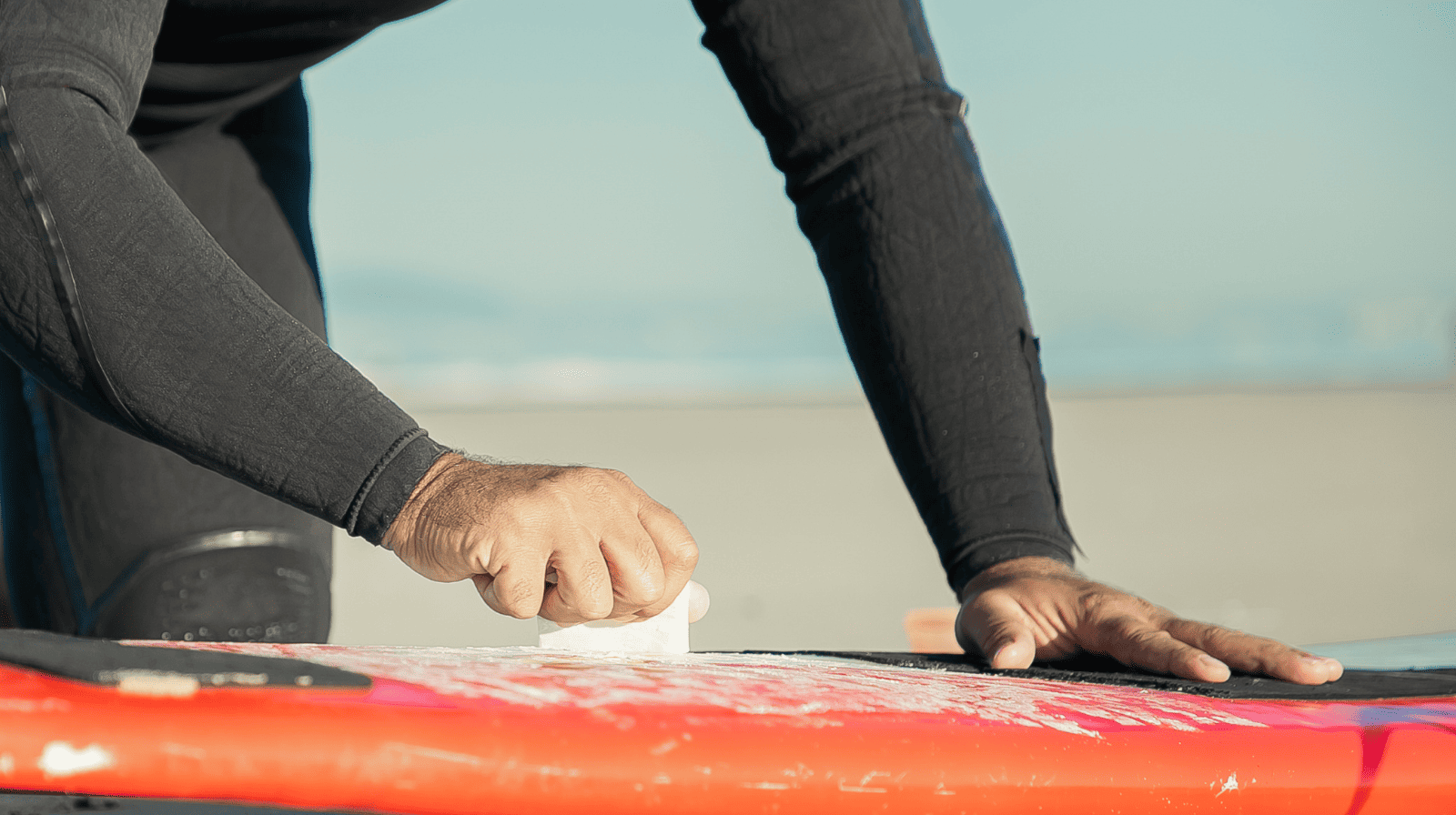
- Remove old wax every 5 to 10 sessions, or when it becomes slippery:
- leave the board in the sun for a few minutes,
- use a wax comb or a plastic card to scrape it off,
- clean any residue with a cloth or a dedicated wax remover.
Apply a thin base coat (optional but recommended), then the topcoat wax. Good wax, properly applied, improves not only
safety but also your overall feel on the board.
3. Repair dings and cracks quickly
Impacts are unavoidable, but untreated cracks are what cause real problems.
Look out for these warning signs:
- visible cracks, air bubbles under the resin,
- delamination (separation between the resin and the foam),
- soft or spongy dents.
What should you do?
- Small cracks: use a UV repair kit or epoxy resin
- Deeper dings: sand, apply resin, let it cure, then sand again.
- Serious damage or unsure? Contact a professional.
Never postpone a repair: it increases the cost and the risk of the board breaking.
4. Protect your board from sun and heat
UV rays are real enemies of your board. They weaken the resin, yellow the coating, and can even cause blistering.
Best protection practices:
- Never leave your board in a closed car, even for a few minutes.
- Use a heat-reflective board bag (preferably silver) to protect it from direct sunlight.
- Always store it in the shade, or cover the board with a thick towel at the beach.
- Avoid sudden temperature changes, which create stress in the fiberglass.
In summer, a board left in the sun can reach 60°C (140°F) on the surface—more than enough to damage the resin.
5. Storage: the often-overlooked step
A good storage routine can extend your board’s life by several years.
Short term:
- lay the board flat or on a padded rack,
- don’t place anything on top of it—especially heavy objects,
- avoid damp or overheated areas.
Long term:
- clean and dry the board thoroughly,
- remove the wax,
- store it in a breathable board bag,
- store it horizontally or on its rail—never upright without proper support.
Poor storage is the number one cause of micro-cracks reported by repair shops.
6. Before and after each session: good habits
Simple actions to adopt every time:
Before surfing:
- inspect your board (cracks, wax, fins),
- check the condition of the fins and that they’re properly secured,
- match your wax to the day’s water temperature.
After the session:
- rinse with fresh water,
- dry in the shade,
- check for any new dings or dents,
- store it in a ventilated space.
These habits limit damage and preserve the performance of your equipment.
Maintenance: a performance factor
It’s not only about longevity. A clean board, well-waxed and crack-free, provides:
- better grip on the wave,
- more precise response under your feet,
- less hydrodynamic disturbance,
- faster progression for the surfer.
Ocean-Ride instructors in Lacanau observe it: a student with well-maintained equipment often progresses twice as fast. Taking care of your surfboard is both simple and essential. By adopting a cleaning routine, repairing damage on time, protecting it from the sun, and storing it correctly, you extend its lifespan while improving your feel on the water.
Ocean-Ride, a surf school in Lacanau, also helps you get comfortable with your equipment and offers personalized advice at every level.
Want to go further? Discover our lessons, camps, and rental packs on ocean-ride.com to surf in the best conditions—with a board that’s always in top shape.
FAQ – Frequently Asked Questions About Surfboard Maintenance
Ideally after every session. Salt water and sand should be rinsed off immediately. A deeper clean (degreasing, wax removal) can be done every 5 to 10 sessions, depending on how often you surf.
It’s not recommended to use standard household products like dish soap or degreasers. They’re often too abrasive and can damage the resin or leave greasy marks. Prefer:
a surf-specific cleaner, or
warm water with a drop of mild, pH-neutral soap.
If the crack is superficial, you can use a quick repair kit (UV resin). You just need to:
lightly sand the area,
apply the resin,
let it cure in the sun or under a UV lamp,
sand again to smooth it out.
Be careful: if the inner foam is visible or damp, consult a professional.
Yes, absolutely. Wax traps impurities, salt residue, and moisture. For long-term storage:
remove all wax with a scraper,
clean off any residue,
dry the board thoroughly before putting it in a breathable board bag.
This helps prevent mold or stubborn stains.
